ChainMo: Chain-Segment Motion Modeling across Arbitrary Skeleton Topologies
ChainMo generates articulated motion across arbitrary skeleton topologies using shared chain-segment tokens and a target-rig-conditioned decoder that produces animation-ready local joint rotations.
Abstract
Generating motion for articulated characters with diverse skeleton topologies remains challenging because existing motion representations are often tightly coupled to the skeletal structures on which they are defined. Position-based representations are relatively flexible across skeletons, but remain sensitive to rig discretization, as the same articulated chain may contain different numbers of joints across rigs. Moreover, converting generated joint trajectories into animation-ready local rotations requires inverse kinematics, introducing ambiguities in under-constrained degrees of freedom such as bone twist. Directly modeling local rotations avoids this post-processing ambiguity, but further entangles motion generation with rig-specific kinematics and local rotation conventions. We address these limitations with ChainMo, a unified framework that separates shared motion modeling from target-rig-specific rotation realization. ChainMo represents motion using a dedicated root token and a variable set of disjoint, non-branching kinematic chain-segment tokens, forming a shared motion abstraction that is robust to variations in within-chain joint resolution. A target-rig-conditioned decoder realizes the abstract motion as coherent local joint rotations without relying on external inverse kinematics. For motion generation, we further introduce a flow-matching model with global spatiotemporal attention over the variable set of chain-segment tokens, enabling shared generative modeling across heterogeneous articulated characters. Extensive experiments on characters with diverse and previously unseen skeletons demonstrate strong generalization across kinematic structures and rig resolutions, accurate reconstruction of local joint rotations, and effective generative modeling in the learned chain-segment latent space.
Method Overview
ChainMo separates shared motion modeling from target-rig-specific rotation realization.
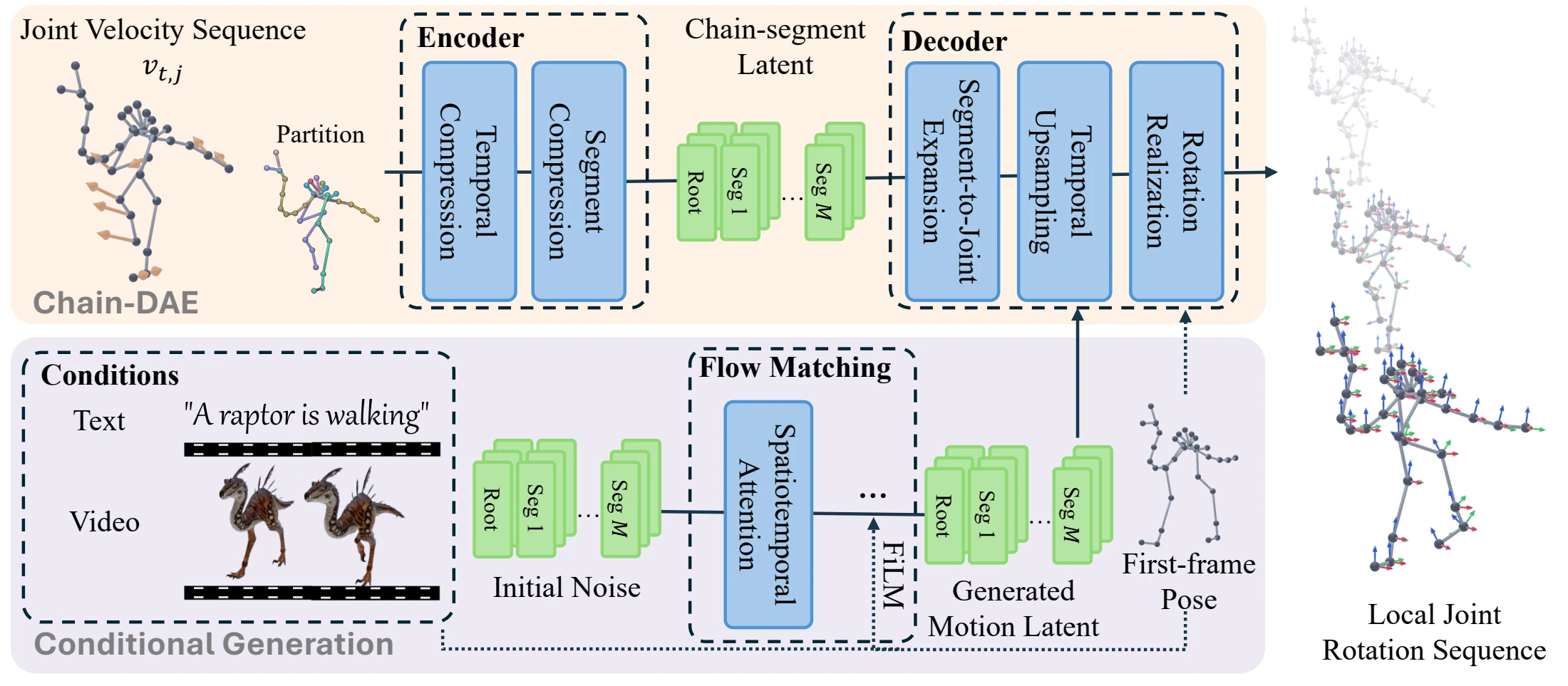
Pipeline overview. A dedicated root token and a variable set of disjoint, non-branching chain-segment tokens represent shared motion dynamics. Global spatiotemporal flow matching generates motion latents, and a target-rig-conditioned decoder realizes them as local joint rotations without external inverse kinematics.
Full resolutionQualitative Comparisons
Generated motions under the same text prompt. Each method is paired with surface normals and recent endpoint trajectories.
Applications
Video-Conditioned Motion
Given a text prompt and an input video, ChainMo generates a motion sequence. Each example shows the input video, generated surface, and world-space normals with endpoint trajectories.
Cross-Skeleton Latent Transfer
Motion latents are transferred using manually specified semantic correspondences between chain segments and decoded on the target skeleton.
HumanML3D
Text-conditioned human motion generation on HumanML3D. Each sequence is shown from four viewpoints with its input prompt.
Resources
The paper and research code will be available here upon release.